
About Advantage+ campaign budget: how it splits spend
Meta’s help article “About Advantage+ campaign budget” only loads with JavaScript. Here is how Advantage+ campaign budget distributes budget across ad sets, and what breaks it, from Meta’s help center as read on October 9, 2026.
On this page · 8 sections
- What is Advantage+ campaign budget?
- How does it distribute budget across ad sets?
- Why does one ad set get most of the budget?
- Why shouldn’t you pause ad sets with low delivery?
- How many ad sets and edits can it handle?
- Should you use ad set spend limits?
- How should you read Advantage+ campaign budget results?
- How does Adwize work with Advantage+ campaign budget?
Advantage+ campaign budget, also called Campaign budget or Budget with Advantage+ on, replaces your ad set budgets with one campaign budget, daily or lifetime. Meta then distributes that budget continuously, in real time, to the ad sets with the best opportunities: more to the ones that get results cheaply, less to the ones that underperform. The split is not equal by design. With 2 active ad sets, Meta may spend most of the money on one if that gives the best overall result, and ad sets with the largest audiences tend to receive the most. That is why Meta asks you to judge results at the campaign level, by total results and average cost per result. Its best practices add a few rules: no more than 70 ad sets, add new ad sets in bulk, avoid pausing and unpausing, keep low-delivery ad sets running, and use ad set spend limits sparingly.
TL;DR
- Advantage+ campaign budget sets one budget and moves it in real time to the ad sets with the best opportunities.
- The split is uneven on purpose. One ad set can take most of the budget, and bigger audiences usually get more.
- Judge it at the campaign level: total results and average cost per result, not ad set by ad set.
- Don’t pause low-delivery ad sets, don’t pause and unpause, and add new ad sets in bulk.
- Adwize reads where the budget went each day and proposes changes you approve.
What is Advantage+ campaign budget?
Advantage+ campaign budget is a Meta setting that manages one central budget across all the ad sets of a campaign. Instead of giving each ad set its own amount, you set a single campaign budget and let Meta decide where each dollar goes. Meta says it is best suited to campaigns with at least 2 ad sets.
You will see it under three names in Ads Manager and in Meta’s help pages: Advantage+ campaign budget, Campaign budget, and Budget with Advantage+ on. Advertisers also know it as CBO.
The budget can be daily, spent each day the campaign runs, or lifetime, spent over the whole campaign. With a lifetime budget you can also run ads on a schedule, and Meta keeps optimizing even when your ad sets have different start and end dates.
How does it distribute budget across ad sets?
Continuously and in real time. Throughout the campaign, Meta sends more budget to the ad sets with the best opportunities and less to the ones that underperform. The aim, in Meta’s words, is the most results possible from your campaign at the lowest cost, not a fair share for each ad set.
Think of it as a single pot that Meta pours where it expects the next result to be cheapest. When an ad set starts finding cheaper results, more budget flows to it. When it slows down, the flow moves elsewhere.
Example. A campaign has a budget of $100 a day and three ad sets: past site visitors, a lookalike audience and a broad audience. On Monday, the lookalike finds purchases at $18 and the others at $30. Meta may give it $70 and split the rest. If the broad audience gets cheaper on Thursday, the split shifts again.
Meta’s summary of the benefits on its budget page: better overall performance, more delivery and more automation, with fewer budgets to manage by hand.
- Campaign budget
- = $100 a day
- Lookalike, purchases at $18
- = about $70
- Visitors and broad, at $30
- = the remaining $30
- Thursday, broad gets cheaper
- = the split shifts again
Why does one ad set get most of the budget?
Because Meta optimizes for the campaign, not for each ad set. Its help page says plainly that Advantage+ campaign budget may not spend your budget equally, and that with 2 active ad sets it might spend most of the budget on one if that is how it gets the best overall results.
Audience size also plays a role. Meta’s best practices note that when audiences differ a lot in size, the ad sets with the largest audiences will likely receive the most budget. A small retargeting audience next to a broad audience of millions will usually get a thin slice.
If that is a problem, two fixes exist. Put very different audiences in separate campaigns, or use ad set budgets, which Meta recommends when audience sizes differ a lot or when you need control over what each ad set spends.
Why shouldn’t you pause ad sets with low delivery?
Because pausing removes the ad set from the budget pool, and the money goes to the others. Meta warns that pausing a low-delivery ad set today stops the system from finding tomorrow’s opportunities in it, which can push up the cost per action of your active ad sets.
Pausing and unpausing causes a second problem. Meta reserves and spends the campaign budget on active ad sets only. Its example: with 2 ad sets, pausing one makes the system spend the whole budget on the other. By the time you unpause the first, there may be no budget left in the campaign.
An ad set that delivers nothing is a different case. Meta says every ad set should be able to deliver: if it finds no opportunities, it cannot receive budget. Fix the delivery issue, such as a rejected ad or a tiny audience, rather than pausing it.
How many ad sets and edits can it handle?
Meta recommends no more than 70 ad sets per campaign. Above that, you are limited in the edits you can make after publishing. More ad sets and ads also means a longer stay in the learning phase, so fewer, stronger ad sets usually help the budget work better.
Timing matters too. Each time you add a new active ad set, Advantage+ campaign budget needs about 2 hours to re-adjust. Meta advises adding ad sets in bulk after the initial setup, rather than one at a time.
The same applies to settings. If you change campaign settings one at a time, the campaign may re-enter the learning phase after each change. Group your edits into one change.
| Topic | What Meta recommends | Why |
|---|---|---|
| Ad sets per campaign | No more than 70 | Edits are limited above 70 |
| Adding ad sets | In bulk, after setup | Re-adjusting takes about 2 hours |
| Pausing and unpausing | Avoid it | Budget may be gone when you unpause |
| Low-delivery ad sets | Keep them running | They hold tomorrow’s opportunities |
| Ad set spend limits | Sparingly, or not at all | Locked budget limits optimization |
| Settings changes | Grouped in one change | Each change can restart learning |
| Reading results | At campaign level | The split is uneven by design |
- Keep the campaign under 70 ad sets
- Add new ad sets in bulk, then wait about 2 hours
- Group setting changes into one edit
- Leave low-delivery ad sets running
- Judge total results and average cost per result
Should you use ad set spend limits?
Only if you must, says Meta. You can set a minimum and a maximum spend for each ad set inside a campaign budget, but the more budget you lock into specific ad sets, the less room the delivery system has to optimize. Meta’s advice is to use them sparingly, or not at all.
Be especially careful when you combine spend limits with a cost or bid control. Too many constraints can make an ad set deliver less than it should, or not at all.
If every ad set has strict budget requirements, Meta suggests a simpler answer: use ad set budgets instead of a campaign budget. Spend limits are for the one exception, not for rebuilding ad set budgets by hand.
How should you read Advantage+ campaign budget results?
At the campaign level. Meta asks you to look at the total number of optimization events for the campaign and the average cost per optimization event, rather than at each ad set. An ad set with a high cost may still be part of the cheapest overall mix.
A useful habit: compare the campaign’s cost per result week over week, and only then look at the split. If the total improved, the uneven split worked. If it got worse, look for the usual causes: a recent edit, a paused ad set, or a new ad set added alone.
Meta may also suggest switching campaigns to Advantage+ campaign budget through opportunity score. It describes these recommendations as experimentally proven, but says the score itself does not reflect or guarantee your performance.
How does Adwize work with Advantage+ campaign budget?
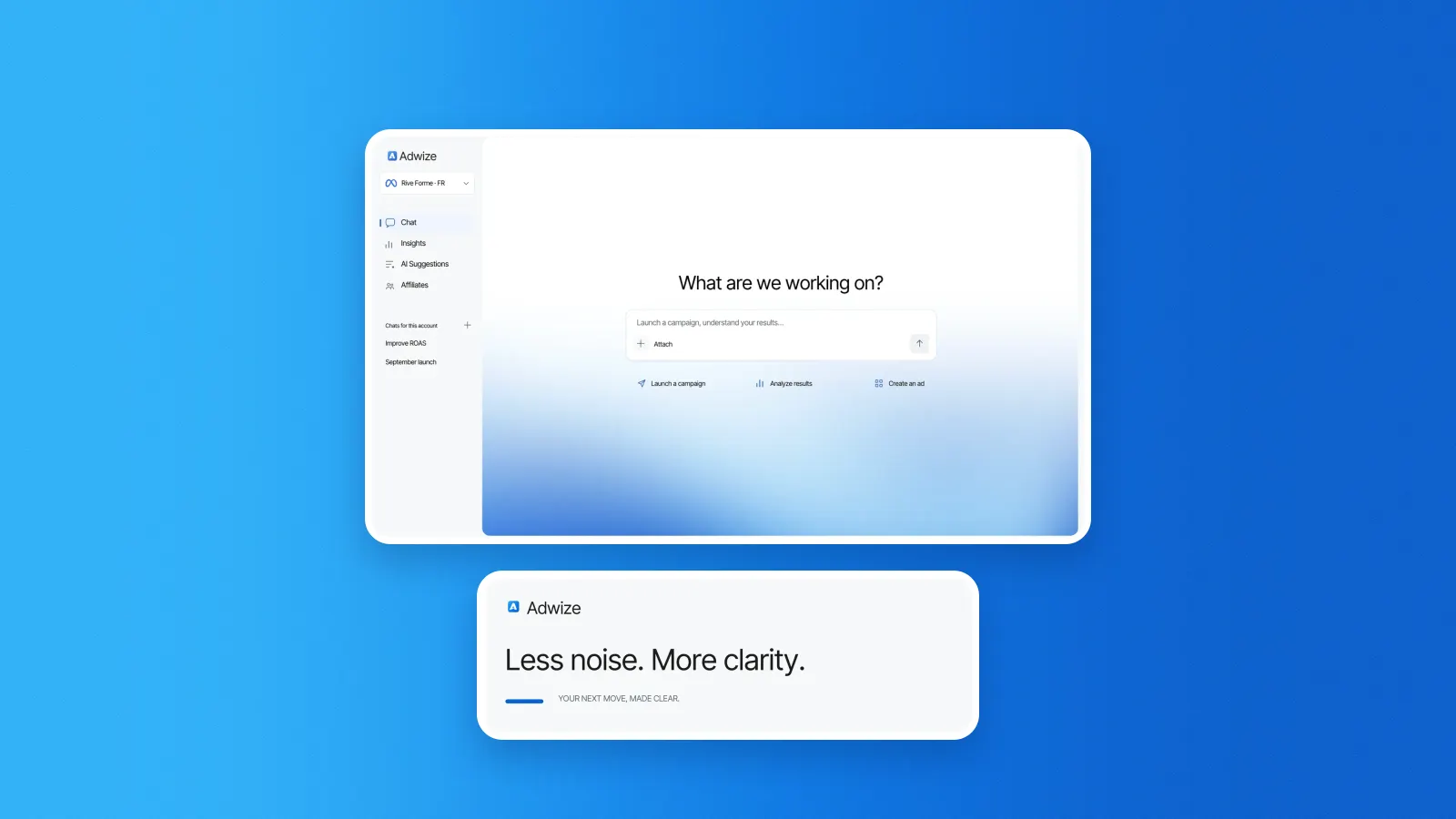
Adwize reads your Meta results each day at the campaign level first, then explains where the budget went and what it bought, in one sentence. When something drifts, such as a cost per result rising after an edit, it proposes the fix and waits for your approval. See the Optimize page.
Use the rules above as your checklist before you approve any change, including the ones Adwize proposes: grouped edits rather than a stream of small ones, and no reflex pausing of low-delivery ad sets. You stay in charge, and nothing changes without your yes.
When you start a new campaign, Adwize prepares it from one sentence, budget strategy included, and shows it before launch. It works with Meta ads only, on Facebook and Instagram. See the Launch page.
Frequently asked questions
Does Advantage+ campaign budget split the budget equally?
No. Meta says it may not spend your budget equally across ad sets. With 2 active ad sets, it might spend most of the budget on one if that gets the best overall results. Ad sets with larger audiences also tend to receive more.
How long does it take to adjust after I add an ad set?
About 2 hours, according to Meta. That is why Meta recommends adding new ad sets in bulk after the initial setup rather than one at a time.
What is the maximum number of ad sets with a campaign budget?
Meta recommends no more than 70 ad sets per campaign. Above 70, you are limited in the edits you can make after publishing, and more ad sets can mean a longer learning phase.
Should I pause an ad set that spends almost nothing?
Meta advises against it. Pausing removes it from the budget pool, prevents the system from finding its future opportunities and can raise the cost per action of the other ad sets. Fix real delivery problems instead.
Can Adwize manage a campaign that uses Advantage+ campaign budget?
Yes. Adwize reads results at the campaign level, explains where the budget went and proposes changes, which you approve or refuse. It does not launch, change or spend anything without your approval.
Sources
- Meta Business Help Center, About Advantage+ campaign budgetAccessed 10/09/2026
- Meta Business Help Center, Best practices for Advantage+ campaign budgetAccessed 10/09/2026
- Meta Business Help Center, About campaign budgets and ad set budgetsAccessed 10/09/2026