Meta Andromeda: what Meta says, what advertisers see, what to change
What Meta’s own posts and earnings calls say about Andromeda, what advertisers only observe, and how to adapt creatives, structure and Advantage+.
On this page · 9 sections
- What is Meta Andromeda?
- Where does Andromeda sit in Meta’s ad selection?
- What has Meta officially said about Andromeda since 2024?
- Why does creative diversity matter more under Andromeda?
- Should you upload more ads, or more different ads?
- Should you consolidate campaigns and ad sets for Andromeda?
- Do you need Advantage+ campaigns for Andromeda to work?
- What is rumor about Andromeda, and what have advertisers only observed?
- What should you stop doing, and in what order should you adapt?
Meta Andromeda is the ads retrieval engine Meta introduced in 2024: the first stage of ad delivery, which narrows tens of millions of eligible ads down to the few thousand that ranking models and the auction then weigh for one person. Meta described it on its engineering blog on December 2, 2024, as a deep neural network co-designed with NVIDIA Grace Hopper and Meta’s own MTIA chips, and said in March 2025 that it enabled a 10,000x increase in the complexity of retrieval models and an 8% gain in ads quality. It is not a setting, a campaign type or a new auction. What it changes is which ads get a chance. Meta now says it groups ads that look or feel alike, so ten color swaps count as variations of one creative and share its learnings. The response: fewer and broader ad sets, genuinely distinct concepts, Advantage+ defaults, and doubt for any claim without a Meta source.
TL;DR
- Andromeda is retrieval: it keeps a few thousand candidates out of tens of millions of ads. Ranking models such as GEM and the auction decide what shows.
- Meta groups ads that look or feel alike as variations of one creative, with shared learnings. Near-duplicates add ads, not concepts.
- Meta also warns that too many ads per ad set can hurt. Diversify concepts, not ad count.
- Consolidate: an ad set usually exits learning after about 50 results in the week after its last significant edit, and merging similar ad sets merges learnings.
- Treat “Entity IDs”, rollout end dates and “targeting is dead” as unverified until Meta says otherwise.
What is Meta Andromeda?
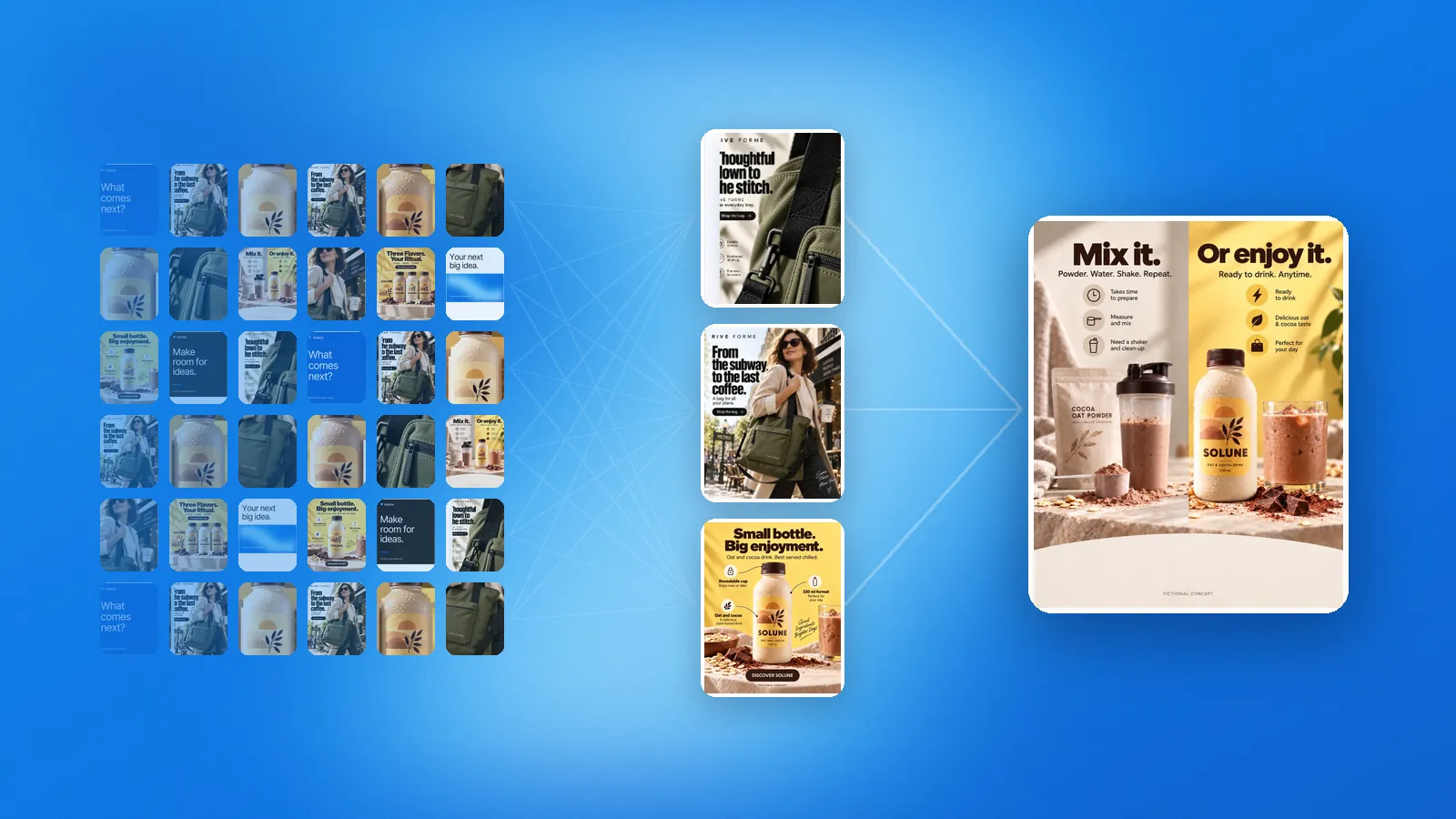
Meta Andromeda is Meta’s personalized ads retrieval engine. Retrieval is the first step of Meta’s multi-stage ad recommendation system: when someone opens Facebook or Instagram, it scans tens of millions of ads and keeps a few thousand relevant candidates. Larger ranking models then predict which of those create the most value for the person and the advertiser.
Meta built it because Advantage+ and generative AI keep adding eligible ads, and the old rule-based retrieval could not scale. Andromeda uses one deep neural network with a hierarchical index trained alongside it. At launch, Meta reported +6% recall and +8% ads quality on selected segments.
You cannot see it or switch it on: no setting in Ads Manager, no campaign type, no status column. It decides which of your ads enter the race for each person, every time an ad can be shown.
Where does Andromeda sit in Meta’s ad selection?
At the very start. Meta’s sources describe four steps: ads become eligible, Andromeda retrieves a few thousand candidates, larger ranking models such as GEM score them, and the auction picks the ad with the highest total value. Your bid, estimated action rates and ad quality only come into play for ads that retrieval kept.
Eligibility still comes from you: Meta’s help page on ad auctions says the ads whose target audience includes the person are the ones eligible to compete. The auction works as before, with total value combining bid, estimated action rates and ad quality, so a more relevant ad can beat a higher bid.
Keep the names straight. Meta says GEM, its Generative Ads Recommendation Model, powers ranking after retrieval, and calls Lattice its ad ranking architecture. Some top-ranking guides present Lattice as the auction or GEM as a creative tool; Meta’s own posts say otherwise.
- Eligible: the ads whose target audience includes the person
- Retrieval (Andromeda): tens of millions of ads narrowed to a few thousand
- Ranking (models such as GEM): value predicted for the person and the advertiser
- Auction: the highest total value wins (bid, estimated action rates, ad quality)
- One ad is shown
What has Meta officially said about Andromeda since 2024?
Less than the guides suggest, and all of it dated. Meta has discussed Andromeda in one engineering post, three Meta for Business posts and several earnings calls. Here is that record in order, limited to what those sources state. Anything missing from this list is someone else’s interpretation.
- December 2, 2024, engineering blog. Andromeda is introduced as the retrieval engine behind Advantage+ automation. A future version should deliver “a more diverse set of ad candidates”.
- March 27, 2025, Meta for Business. A 10,000x increase in retrieval model complexity and an 8% increase in ads quality, tied to advertisers uploading more creatives.
- April 22, 2025, Meta for Business. The focus “has shifted from niche targeting to creative diversification”.
- July 30, 2025, Q2 earnings call. Introduced from the second half of 2024; extended to Facebook Reels in Q2, for nearly 4% more conversions on Facebook mobile Feed and Reels.
- October 29, 2025, Q3 earnings call. Retrieval and early-stage ranking merged into one model: +14% ads quality on Facebook surfaces.
- December 16, 2025, Meta for Business. Ads sharing key visual and thematic attributes are grouped and share learnings.
- July 29, 2026, Q2 earnings call. Meta deployed its first generative model into ads retrieval, without naming Andromeda in that passage.
What is missing matters too: no “Andromeda update” date for advertisers, no date when a rollout finished, no recommended number of ads per ad set.
Why does creative diversity matter more under Andromeda?
Because retrieval now chooses between your creatives person by person, and Meta does not treat near-duplicates as separate ideas. Meta says its system groups ads that look or feel alike as variations of the same creative, with shared learnings and delivery optimizations. Ten color swaps are variations of one concept; distinct concepts give Andromeda real alternatives.
Meta separates iteration (identical visuals, a different call-to-action text) from diversification (distinct pieces for different personas or use cases). It also separates creative fatigue, the same image seen too often, from creative similarity, ads that look too alike, which it says can also drive fatigue.
Our test: a concept is different when a stranger would describe it differently. Another buyer motivation, another story, another format. Meta’s own example is one ad built on emotional appeal and another on product features. To test concepts without burning budget, use our method for testing visuals without waste.



Should you upload more ads, or more different ads?
More different ads, not more ads. Meta’s help page on managing ad volume still says that when an advertiser runs too many ads at once, each ad delivers less often, fewer ads exit learning, and too many ads can result in worse performance. Its advice is fewer ads per ad set, with diverse creative assets in each.
The same page gives the mechanics: one ad can hold up to 10 creative assets, and multiple text optimization tests several texts inside one ad. Check the ad specs by placement so each format fits.
Some advertisers report good results with far more ads per ad set since Andromeda: Jon Loomer, for one, describes an ad set with 50 ads. That is an observation, and Meta publishes no number. Our rule: one concept per ad, its variants inside it, and a new ad only for a new concept. When a concept wears out, spot the fatigue and replace the concept, not the color.
Should you consolidate campaigns and ad sets for Andromeda?
In most accounts, yes. Not because Meta says Andromeda requires it, since it has not, but because learning does. An ad set usually exits learning after about 50 results in the week after its last significant edit, and Meta says that combining similar ad sets also combines their learnings. Fewer ad sets, faster learning.
Meta’s ad volume page lists what to merge: ad sets split by audience, area, placement or language. Ad sets that reach the same people also compete in the same auctions, as shown in ad sets that compete with each other.
Example. Six ad sets split by interest each get 20 purchases a week: 120 in total, but none reaches about 50, so each is likely to show “Learning limited”. Merged into one broad ad set, the same 120 purchases clear the bar. The figures are illustrative; the threshold is Meta’s.
Keep separate only what needs its own goal or budget: another objective, another offer, a market with other margins. Then decide where the budget lives with our guide to CBO vs ABO.
- 6 ad sets × 20 purchases a week
- = none reaches about 50
- 1 ad set × 120 purchases a week
- = clears about 50
- Meta’s threshold
- = about 50 results in the week after the last significant edit
Do you need Advantage+ campaigns for Andromeda to work?
No. Andromeda does retrieval for Meta’s ads system as a whole; it is not an Advantage+ feature. But Meta built it to handle the volume Advantage+ creates, and since Q3 2025, sales, app and lead campaigns start with end-to-end automation turned on. For most sales campaigns, keep those defaults and change one only with a reason.
Meta’s own figure is a 9% lower cost per action, on average, with the streamlined setup for Advantage+ sales campaigns. It is an average across advertisers: a reason to test, not a promise.
Keep manual only what the business imposes, such as locations you cannot serve. If you start from scratch, Adwize builds the campaign from one sentence and shows it to you for approval before anything goes live.
What is rumor about Andromeda, and what have advertisers only observed?
Most of what circulates as “the Andromeda update” is extrapolation from the sources above. Our rule: a claim with no Meta source is a hypothesis to test in your own account, not a fact to rebuild it on. The table below sorts the common claims into what Meta says, what advertisers observe and what remains unverified.
- “Entity IDs”, one auction ticket per cluster. Meta confirms the grouping. The term appears in none of the Meta pages we read, and none says a group gets one ticket.
- “Andromeda reads your images with computer vision.” Meta says its ads system analyzes creatives, not which model does it or where.
- “The rollout finished in October 2025.” Meta gives no end date, and the top guides disagree with each other.
- “Targeting is dead.” Meta’s auction page still says the target audience sets eligibility.
- “Creatives fatigue in two to four weeks now.” AdScale’s guide says top ads can drop off after 2 to 4 weeks, without data. Meta has published no such figure.
| Claim | Status | Source | What to do |
|---|---|---|---|
| Similar ads are grouped and share learnings | Meta says | Meta for Business, Dec 2025 | Count concepts, not ads |
| Too many ads can hurt performance | Meta says | Help Center, ad volume | Fewer ads, more distinct assets |
| Far more ads per ad set work better | Advertisers observe | Jon Loomer; no Meta figure | Test it, watch learning status |
| “Entity ID”: one auction ticket per cluster | Unverified | Term absent from Meta sources | Keep the lesson, drop the mechanics |
| Rollout finished in October 2025 | Unverified | Meta gives no end date | Compare your own before and after |
| Creatives fatigue in 2 to 4 weeks | Vendor claim | AdScale; no Meta figure | Watch frequency and cost per result |
| Targeting no longer matters | Overstated | Audience still sets eligibility | Go broad, keep business exclusions |
What should you stop doing, and in what order should you adapt?
Stop splitting budgets by interest, stop shipping color swaps as new ads, and stop editing ad sets while they learn. Then adapt in this order, because each step makes the next one measurable: consolidate, rebuild the creative mix around concepts, keep Advantage+ defaults, and judge the result over full weeks.
- Merge similar ad sets until each can reach about 50 results a week.
- Count concepts, not ads. Twelve ads built on two ideas are two concepts.
- Brief one concept per buyer motivation, with its formats and texts inside one ad.
- Read weekly, not daily, and replace a tired concept with a new one.
Adwize takes the repetitive part. It creates ad creatives and copy in your brand style from your brief, then reads your results, flags what drifts and proposes changes you approve (see Optimize). Nothing changes without your yes. Starter costs $69 a month, with a free trial with credits.
Frequently asked questions
When did Meta launch Andromeda?
Meta published its engineering post on December 2, 2024, and said on its Q2 2025 earnings call that it began introducing Andromeda in the second half of 2024. It has given no end date for the rollout.
Is Andromeda the same as GEM or Lattice?
No. Andromeda does retrieval, the shortlist. Meta describes GEM as the model behind ranking and Lattice as its ranking architecture. The auction comes last.
Can I turn off Andromeda in Ads Manager?
No. It has no setting or column. You control what it receives: your creatives, your structure and the limits of your targeting.
How many ads should an ad set have under Andromeda?
Meta publishes no number. It warns that too many ads deliver less each, and suggests fewer ads with diverse assets, up to 10 per ad.
Did the Andromeda update cause my ROAS drop?
Check the usual causes first: tracking, learning resets, fatigue, overlap, budget jumps. Meta has published no account-level effect of Andromeda, so a drop needs a diagnosis, not a label.
Sources
- Engineering at Meta, Meta Andromeda: Supercharging Advantage+ automation with the next-gen personalized ads retrieval engine (December 2, 2024)Accessed 09/24/2026
- Meta for Business, AI Innovations in Meta’s Ad Ranking Driving Advertiser Performance (March 27, 2025)Accessed 09/24/2026
- Meta for Business, The Creative Advantage: Unlocking the Power of Diversification with Meta Andromeda (April 22, 2025)Accessed 09/24/2026
- Meta for Business, Demystifying Creative Diversification (December 16, 2025)Accessed 09/24/2026
- Meta, Q2 2025 earnings call transcript (July 30, 2025)Accessed 09/24/2026
- Meta, Q3 2025 earnings call transcript (October 29, 2025)Accessed 09/24/2026
- Meta, Q2 2026 earnings call transcript (July 29, 2026)Accessed 09/24/2026
- Meta Business Help Center, About ad auctionsAccessed 09/24/2026
- Meta Business Help Center, About the learning phaseAccessed 09/24/2026
- Meta Business Help Center, About managing ad volumeAccessed 09/24/2026
- Not Meta: Jon Loomer, Meta Andromeda: What It Means for Your Ad Strategy (advertiser observation)Accessed 09/24/2026
- Not Meta: AdScale, Meta Andromeda Update (vendor claim on creative lifespan)Accessed 09/24/2026