How to scale Facebook ads: when to raise the budget and when to go wide
A decision method for scaling Meta ads, built on Meta’s Business Help Center: when an ad set is ready, how big a budget step can be, when to go horizontal, and how to tell if the extra spend pays.
On this page · 9 sections
- When are your Facebook ads ready to scale?
- Is it profitable to scale your Facebook ads?
- How does vertical scaling work, and how fast can you raise the budget?
- How does horizontal scaling work?
- Vertical vs horizontal scaling: which comes first?
- How does Advantage+ campaign budget change scaling?
- Which mistakes break a scale?
- What does a scale look like with real numbers?
- How do you keep watch while you scale?
To scale Facebook ads without losing ROAS, wait until an ad set has left the learning phase and has kept its cost per result under your target for a full week, then add budget in one measured step and judge only what the extra spend buys. Meta says an ad set usually exits learning after about 50 results in the week after its last significant edit. Vertical scaling raises the budget of a winner: Meta’s own example is that going from $100 to $101 is unlikely to restart learning, while $100 to $1,000 may. Horizontal scaling adds reach instead, with a new audience or a genuinely different creative in a new ad set, so the winner keeps running untouched. With Advantage+ campaign budget, adding an ad set does not send the others back into learning. One rule decides every step: keep scaling while the extra revenue divided by the extra spend stays above your break-even ROAS.
TL;DR
- Scale only an ad set out of learning, with cost per result under target for a full week. Meta puts the exit at about 50 results a week.
- Judge the increment, not the average: extra revenue divided by extra spend must stay above your break-even ROAS.
- Vertical: raise the budget in one step, batch other changes, then wait. Meta gives no safe percentage, only $100 to $101 versus $100 to $1,000.
- Horizontal: add a new ad set with a new audience or a distinct creative. Duplicates of the winner overlap: Meta lets only one of your ads into each auction.
- Adwize proposes each change, waits for your approval and applies the cost rules you set while you scale.

When are your Facebook ads ready to scale?
Scale an ad set when two things are true: it has left the learning phase, and its cost per result has stayed under your target for at least a full week. Before that, Meta says performance is less stable and results are not necessarily indicative of future performance, so you would be scaling noise, not a winner.
Check three columns in Ads Manager:
- Delivery. Active, not “Learning” or “Learning limited”. Meta says an ad set usually exits learning after about 50 results in the week after its last significant edit.
- Last significant edit. Count a full week from that date. Our lesson on the learning phase explains why that week matters.
- Cost per result, week by week. Compare full weeks, not days. One cheap Tuesday proves nothing.
- Delivery reads Active, not Learning
- About 50 results in the week since the last significant edit
- Cost per result under target for a full week
- After each step, marginal ROAS above break-even
Is it profitable to scale your Facebook ads?
It is profitable to scale as long as each extra dollar returns more than your break-even ROAS, which is 1 divided by your gross margin. With a 40% margin, break-even is 2.5. The average ROAS of the ad set can stay healthy while the extra spend loses money, so compute both.
The reason is in Meta’s delivery logic: when your budget is well above usual, Meta says it spends it on the lowest-cost opportunities first, then moves on to more costly ones. Each new dollar tends to buy a slightly pricier result than the one before.
So measure the increment: compare the full week before the raise with the full week after, and divide the extra revenue by the extra spend. That is your marginal ROAS. Try it in the calculator below or the full ROAS calculator.
- Break-even ROAS
- = 1 ÷ gross margin
- Marginal ROAS
- = extra revenue ÷ extra spend
- Example below
- = 720 ÷ 350 = 2.06, under 2.5
How does vertical scaling work, and how fast can you raise the budget?
Vertical scaling means raising the budget of an ad set or campaign that already works, and touching nothing else. Meta publishes no safe percentage. Its help center says a budget change may or may not be a significant edit depending on its size: $100 to $101 is unlikely to restart learning, $100 to $1,000 may.
Many guides prescribe a fixed percentage every few days: a habit, not a Meta rule, and daily nudges hide which step raised your costs. Meta asks for a budget large enough to get enough results, and no frequent budget changes. The method:
- Make the raise in one step, sized to what the extra results are worth to you.
- Put any other change into the same edit. For Advantage+ campaign budget, Meta recommends entering changes in bulk: made one at a time, they may send the campaign back into learning each time.
- Leave it alone until the Delivery column is stable again and a full week has passed.
- Read the increment. Keep the new budget only if the marginal ROAS clears your break-even.
What you stop doing: raising the budget during learning. Meta recommends waiting until an ad set is out of it, because an edit then resets learning and delays optimization.
How does horizontal scaling work?
Horizontal scaling adds reach instead of budget: a new audience or a new creative concept, usually in a new ad set, so the winner keeps running untouched. Switch to it when the winner’s extra dollars start buying costlier results, or when its audience and creative wear out.
New audiences. Widen what works: a broader audience, a larger lookalike audience or a new market. Do not duplicate the winner with the same audience. Meta says that when several of your ads reach the same people, only one enters each auction, and that too much auction overlap makes performance less predictable, especially when scaling your budget. See ad sets that compete with each other.
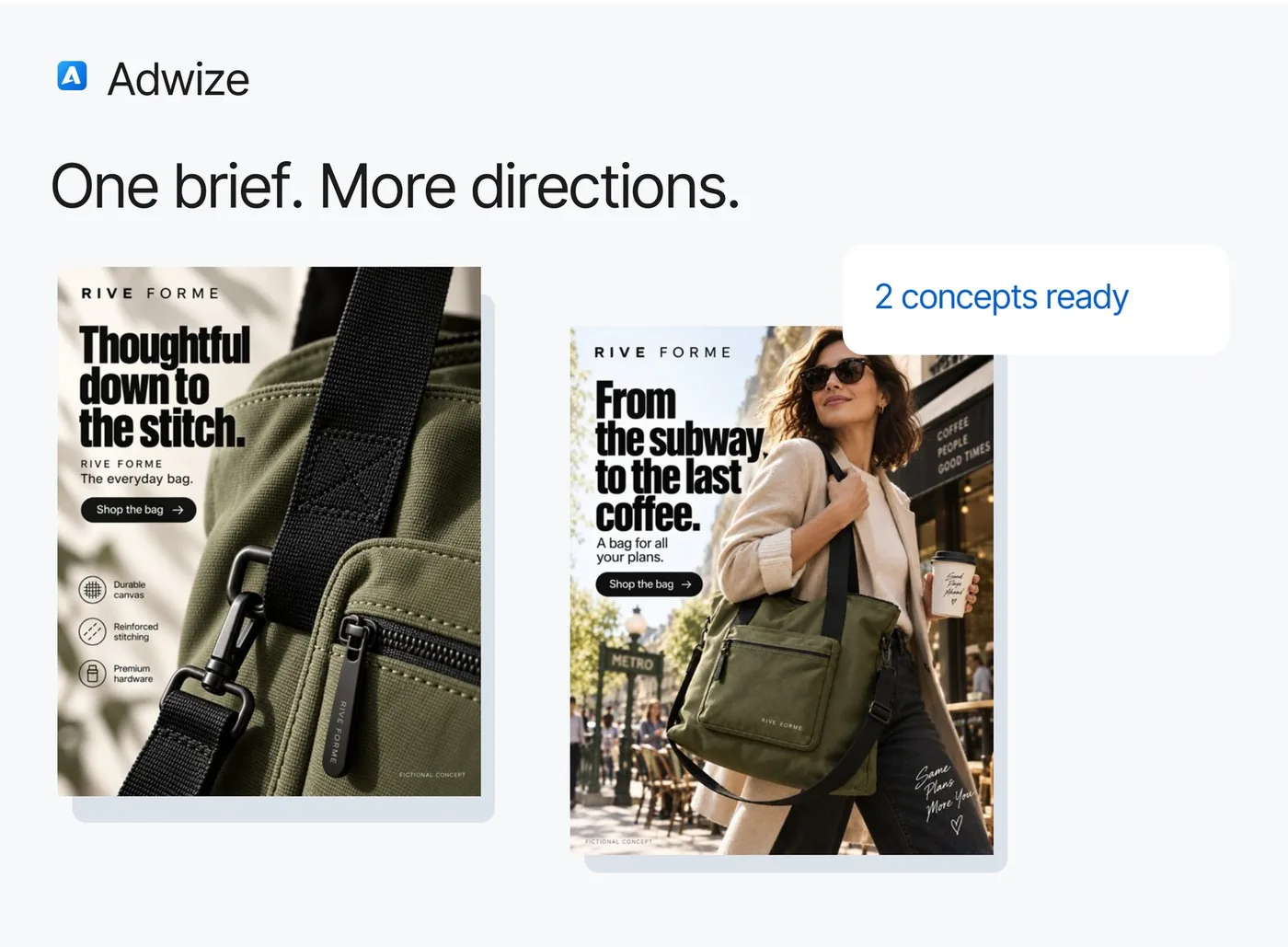
New creatives. Meta counts adding an ad to an ad set as a significant edit, so give a new concept its own ad set. Make it genuinely different: Meta explained in December 2025 that its system groups ads that look alike and treats them as variations of the same creative. A new headline on the same image is iteration; a new angle, format or persona is diversification.
If the winner shows fatigue, see spotting ad fatigue. For new concepts, Adwize creates ad creatives and copy in your brand style.
Vertical vs horizontal scaling: which comes first?
Start vertical, because it changes one number on something proven. Switch to horizontal when the increment stops paying: when the marginal ROAS of the last budget step falls under break-even, or when the ad set drifts into learning limited. Most accounts alternate the two: raise, read, then widen.
The table compares five moves, based on Meta’s pages.
| Move | What you change | Restarts learning? | Use it when | Watch for |
|---|---|---|---|---|
| Small budget raise | Budget of a stable ad set | Unlikely, per Meta | Cost holds under target | Marginal ROAS |
| Large budget jump | Budget, in one big leap | May, per Meta | Rarely: split it into steps | Costlier results, learning reset |
| New audience | Targeting, in a new ad set | The new ad set learns | The winner’s audience wears out | Auction overlap |
| New creative concept | A distinct ad, in a new ad set | Yes, if added to the winner | Frequency up, results flat | Look-alike variations |
| Ad set added to campaign budget | One more ad set | Not for the other ad sets | You use Advantage+ campaign budget | Campaign-level results |
How does Advantage+ campaign budget change scaling?
With Advantage+ campaign budget, the setting once called campaign budget optimization (CBO), you scale at the campaign level: one budget that Meta distributes in real time to the ad sets with the best opportunities. Meta says adjusting that budget might send several ad sets back into learning, so a campaign raise weighs more than an ad set raise.
It also makes horizontal scaling cleaner: Meta says adding an ad set to such a campaign does not send the other ad sets back into learning. Its best practices for this setup:
- Add new ad sets in bulk. The budget can take about 2 hours to readjust after each new active ad set.
- Do not pause ad sets with low delivery: Meta says it can raise your cost per result.
- Use ad set spend limits sparingly, and keep to 70 ad sets or fewer per campaign.
- Read results at the campaign level, not ad set by ad set.
Meta says the setting suits campaigns with at least 2 ad sets. Our CBO vs ABO guide compares it with ad set budgets.
Which mistakes break a scale?
Most failed scales come from edits, not from the budget itself: too many changes too close together, duplicates that overlap in the same auctions, and decisions taken on one day or one ad set. Each of these either restarts learning or hides what the extra spend actually bought.
- Stacking edits. A budget change on Monday, a new ad on Wednesday, a new audience on Friday: Meta counts the ad and the targeting change as significant edits.
- Duplicating the winner. Same audience, same creative, one more ad set: more auction overlap, not more reach.
- Pausing for 7 days or longer. Meta counts it as a significant edit: the ad set goes back into learning when you turn it on again.
- Judging the average. A campaign ROAS above target can hide a last budget step that loses money.
If a scale already went wrong and ROAS is falling, run the checks in why your Meta ads ROAS is dropping before you change anything else.
What does a scale look like with real numbers?
Example, with invented round numbers to show the method: an ad set spends $150 a day, sells a $60 product at a 40% gross margin and has been out of learning for two weeks. Its cost per purchase holds at $17.50 against a $20 target. By the checks above, it is ready to scale.
- Week before the raise: $1,050 spent, 60 purchases, $3,600 in revenue. ROAS 3.43, cost per purchase $17.50. Break-even ROAS is 1 ÷ 0.40 = 2.5, and break-even cost per purchase is $60 × 0.40 = $24.
- The raise: one step to $200 a day, nothing else changed.
- Full week after: $1,400 spent, 72 purchases, $4,320 in revenue. ROAS 3.09, cost per purchase $19.44. On average, still under target.
- The increment: $350 more spend bought 12 more purchases and $720 more revenue. Marginal ROAS is 720 ÷ 350 = 2.06, under the 2.5 break-even, and each extra purchase cost $29.17, above $24. Gross profit after ad spend fell from $390 to $328 a week.
The decision: bring the ad set back toward $150 a day and put the next dollars into a horizontal move, such as a new ad set with a distinct creative. The average said keep going; the increment said stop.
How do you keep watch while you scale?
Write your stop rule before you raise the budget, then check it every day: for example, cost per purchase above break-even three days in a row. The rule turns a scale into a test with an exit, so a bad step costs you days instead of a month.
Adwize can hold that rule for you. It applies rules you set, such as alert me if cost goes over my limit three days in a row, and monitors accounts 24/7 on the Growth plan: see the Automate page. It also reads your results every day, flags what drifts and proposes changes you approve or refuse, and it does not change or spend anything until you approve: see the Optimize page. Plans are billed monthly or yearly, and you can cancel anytime.
Frequently asked questions
How much should I increase my Facebook ad budget at a time?
Meta gives no percentage. It says a budget change may restart learning depending on its size: $100 to $101 is unlikely to, $100 to $1,000 may. Raise in one measured step, wait a full week, then judge the marginal ROAS.
Should I duplicate a winning ad set to scale it?
Not with the same audience. Duplicates reach the same people, so only one of your ads enters each auction, and Meta says heavy auction overlap makes performance less predictable when you scale. Use a new audience or a distinct creative.
What is the difference between vertical and horizontal scaling?
Vertical scaling raises the budget of what already works. Horizontal scaling adds new audiences or new creatives, usually in new ad sets. Start vertical, and go horizontal when the extra spend stops clearing your break-even ROAS.
When should I stop scaling?
When the extra revenue divided by the extra spend falls below your break-even ROAS, 1 divided by your gross margin. The last step then loses money, even if the average ROAS still looks good.
Sources
- Meta, About the learning phaseAccessed 09/24/2026
- Meta, Significant edits and learning phaseAccessed 09/24/2026
- Meta, About learning limitedAccessed 09/24/2026
- Meta, Best practices to potentially reduce cost per resultAccessed 09/24/2026
- Meta, About Advantage+ campaign budgetAccessed 09/24/2026
- Meta, Best practices for Advantage+ campaign budgetAccessed 09/24/2026
- Meta, Understand auction overlapAccessed 09/24/2026
- Meta for Business, Demystifying creative diversification (December 16, 2025)Accessed 09/24/2026